Independent project / AI & full-stack engineering
AI work.
With something
to show for it.
Tanstafl connects business context, agent execution and human review. Every work item keeps its goal, result and supporting evidence together.
Explore the workflow ↓Visit Tanstafl ↗A useful answer is only the beginning.
An AI conversation can propose a direction, but delivering it takes more: shared context, a bounded task, an execution history and a way to judge the outcome. Tanstafl brings those pieces into one workspace.
I developed the Angular interface and Haskell/PostgreSQL backend, connecting structured LLM responses, reviewable action proposals, coding-agent execution and result inspection. This is my independent engineering project.
Product walkthrough
Context. Work. Evidence.
Explore three views of the interface. These are browser-test captures using sandbox data; they show the product without requiring a workspace account.
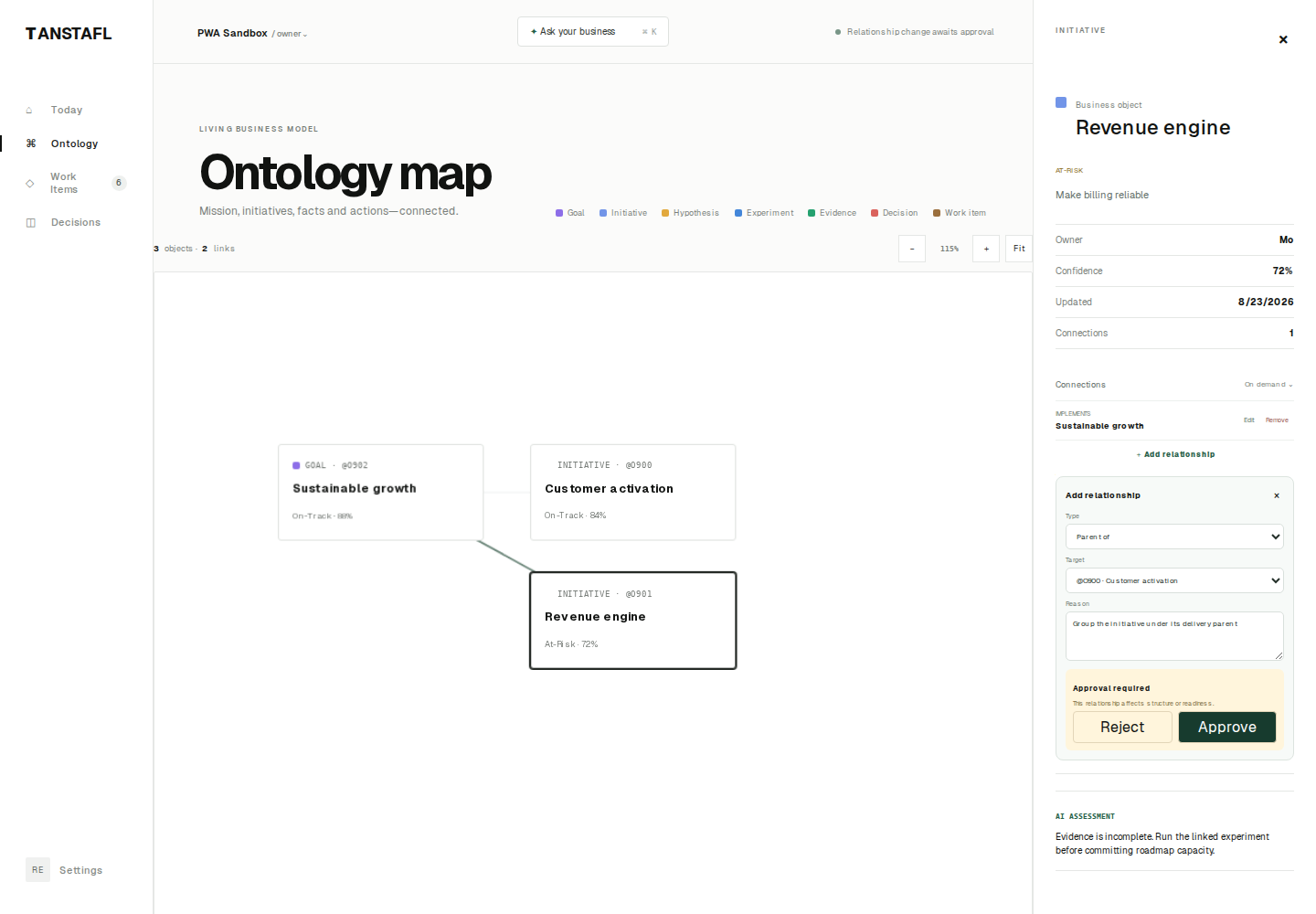
01 · Keep the business model connected.
Goals, initiatives, facts and work items live in a shared model. Proposed relationship changes are presented for approval, so the user can inspect what will change.
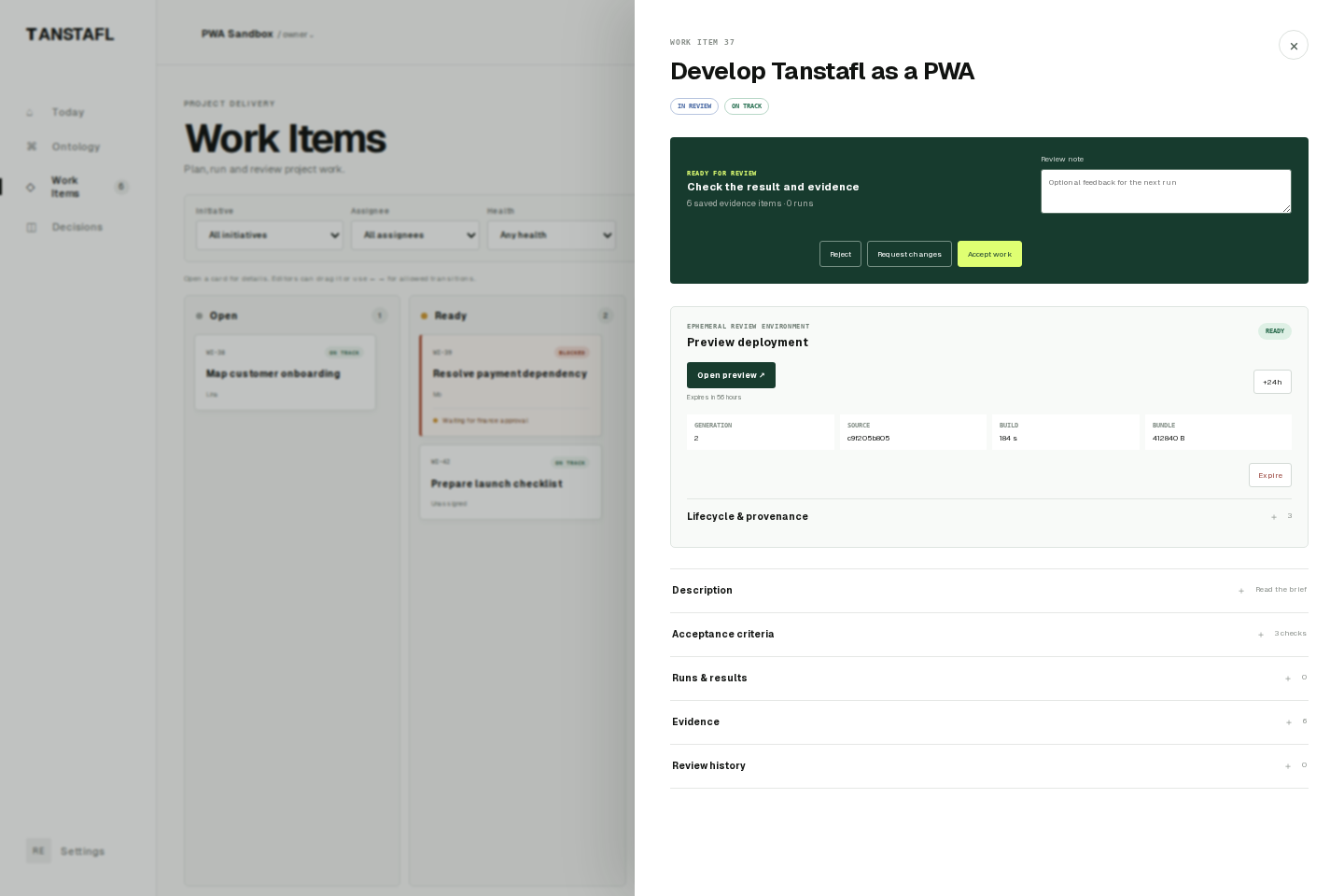
02 · Bring execution back to a decision.
A work item carries its description, acceptance criteria, agent runs and review history. The reviewer can inspect a preview, accept the work, reject it or request changes.
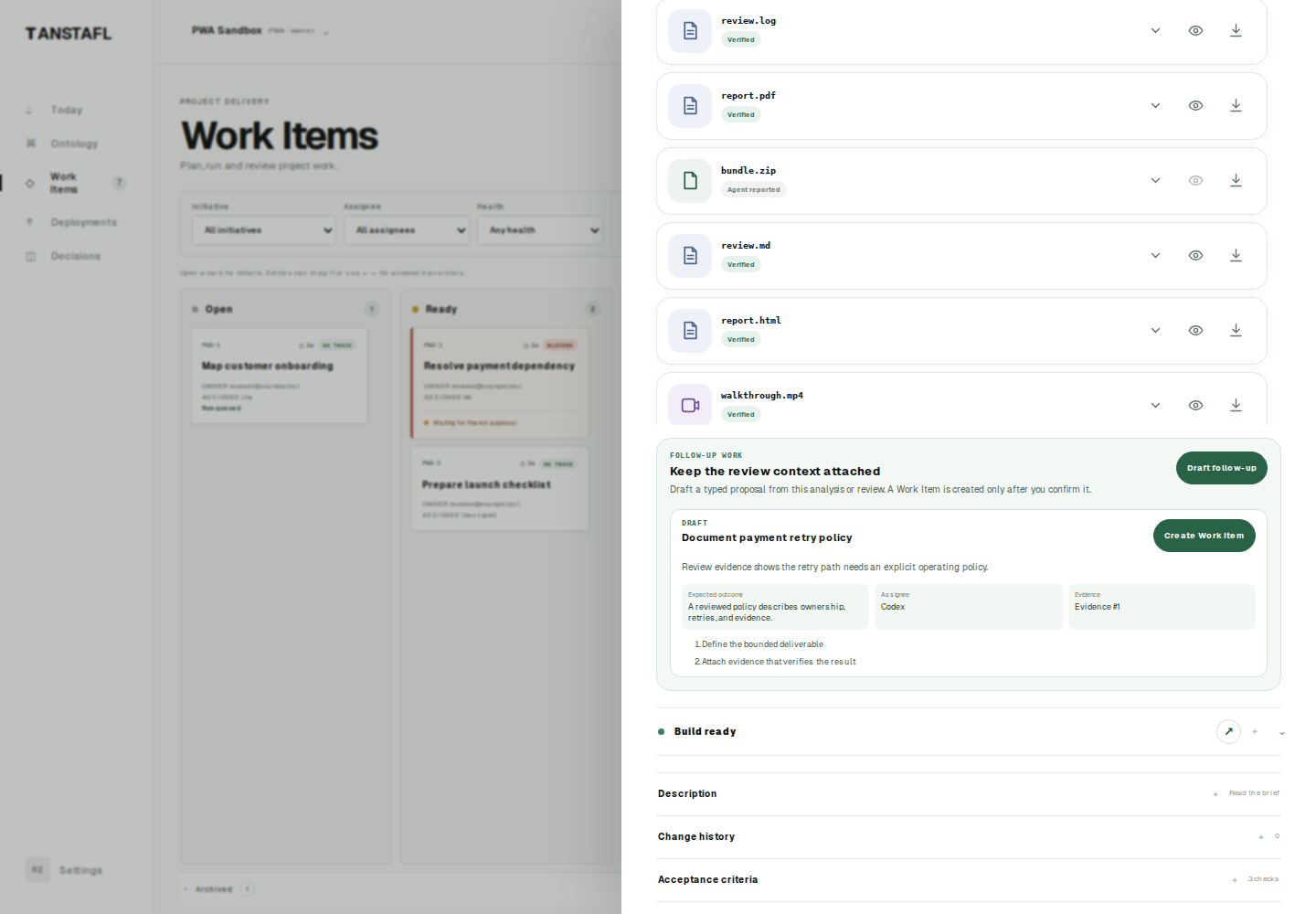
03 · Keep the result attached to its proof.
Logs, reports, recordings and other artifacts stay with the work. Follow-up proposals retain that context and become new work items only after confirmation.
The engineering behind the workflow.
Structured responses with source references.
The Haskell API supplies project context to the LLM and parses a defined JSON response schema. Answers refer back to context objects. Tool calls become proposals for review, with their requested arguments represented explicitly.
Agent execution with a lifecycle.
The execution integration submits bounded coding missions, tracks status and captures structured results, usage and failures. Idempotency and correlation identifiers connect a request to its run.
Review environments tied to source.
The review tooling resolves an immutable source commit and a digest-pinned builder. Build execution has a timeout, explicit failure states and cleanup. The UI exposes a preview alongside the work that produced it.
A full-stack product boundary.
Angular handles the workspace, graph, work board and review panels. Haskell owns API behavior, authorization and persistence; PostgreSQL stores project and execution state. Browser checks exercise workflows and responsive layouts.
What I would show in a live demo.
Start with a project goal, inspect a proposed action, follow an agent run, then review its artifacts and decide what happens next. The interesting part is how those steps stay connected when work fails or needs revision.
Tanstafl is an independent project in development. The captures show selected implemented interfaces; they are not a recording of a single production run.
Discuss the project ↗More selected work →